Transport machinery of the mycobacterial cell envelope
The bacterial envelope is a fortress of lipids and proteins. We work at near-atomic resolution to understand how mycobacteria move substances across this complex barrier.
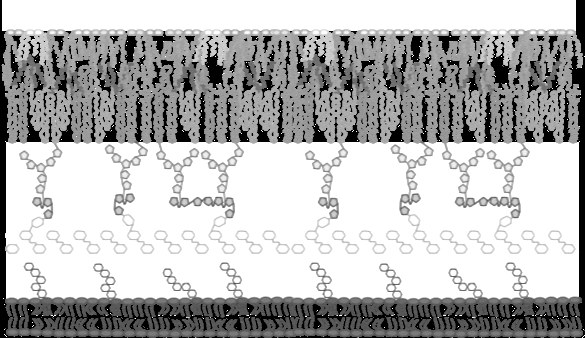
Mycobacteria include some of the world's deadliest pathogens, with Mycobacterium tuberculosis responsible for over a million deaths every year. Despite their importance, we still understand very little about how mycobacteria move substances across their unusual, multi-layered cell membrane.
Our aim is to discover and characterise the proteins that reside in the mycobacterial outer membrane. By combining structural biology, microbiology and biochemistry, we uncover the molecular mechanisms behind the transport of molecules in and out of the cell — and, in the longer term, hope this opens new avenues for antibiotic discovery.
Outer membrane transporters
The identification and characterisation of understudied classes of mycobacterial outer membrane proteins (MOMPs) is the primary focus of the group.
Type VII secretion systems
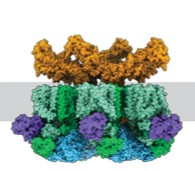
My earlier research focused on the structure and function of the mycobacterial type VII secretion (T7SS / ESX) systems — the machinery that moves proteins across the mycobacterial envelope and lets M. tuberculosis establish infection. Using cryo-EM and single-particle analysis we determined structures of the ESX-5 membrane and pore complexes, revealing how these machines are built and how they might be targeted for drug development.
- 2021 Beckham KSH, Ritter C, Chojnowski G, et al. Structure of the mycobacterial ESX-5 type VII secretion system pore complex. Science Advances.
- 2021 Lagune M, Petit C, Vásquez Sotomayor F, Johansen MD, Beckham KSH, et al. Conserved and specialized functions of Type VII secretion systems in non-tuberculous mycobacteria. Microbiology.
- 2020 Crosskey TD, Beckham KSH, Wilmanns M. The ATPases of the mycobacterial type VII secretion system: structural and mechanistic insights into secretion. Progress in Biophysics and Molecular Biology.
- 2017 Beckham KSH, Ciccarelli L, Bunduc CM, et al. Structure of the mycobacterial ESX-5 type VII secretion system membrane complex by single-particle analysis. Nature Microbiology.
Tools for working with mycobacteria
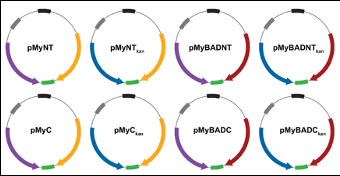
We have developed a series of protein-expression vectors — the pMy vector series — for producing mycobacterial proteins in M. smegmatis, our workhorse expression host.
The plasmids are freely available through Addgene, and are described in full in our Protein Science paper.